
Value Proposal
The market has moved from Metadata Management to Active Metadata and Data & Analytics Governance platforms; in 2025, Gartner launched the first Magic Quadrant for this segment. It selected 16 vendors and placed Anjana Data as a Niche Player, the only Spanish company in the Data Management quadrant, confirming its maturity and relevance.
Two distinct sets of solutions
All-in-one data and AI platforms with governance capabilities
Ingestion, storage, processing and analytics suites that incorporate catalogues and governance functions centred on their own platform (usually with a technical focus and limited business expertise). Examples: Microsoft, AWS, Google, IBM, Oracle, SAP, Informatica, Qlik, Denodo, Cloudera, HPE, Snowflake, Databricks, Teradata, Stratio, etc.
Data Governance & AI Platforms (agnostic and cross-functional)
They provide a common, multi-platform, multi-technology governance layer for the entire Data & AI ecosystem. This is where Anjana Data Platform comes in, competing in capabilities with Collibra, Informatica, Erwin, Atlan, Alation, and DataGalaxy.
When each approach fits and why Anjana Data is different
If the priority is govern a current/future heterogeneous ecosystem (on-premises, cloud, multi-cloud, hybrid), a cross-functional governance platform reduces dependency and prevents lock-in. Anjana Data natively integrates with technologies from major cloud providers and data platforms to metadata extraction and injection, sampling, and permission management, orchestrating a active government above native catalogues. This preserves investment and maintains governance. agnostic and portable if architecture evolves.
Technical Data Catalogs vs. Data & Analytics Governance Platforms

Technical catalogues
The technical catalogues (e.g., Purview, Dataplex, Glue, Atlas, OpenMetadata, DataHub, Unity) prioritise automatic discovery of technical assets, technical lineage, and stack visibility, with strong coupling to specific platforms.
Government platforms
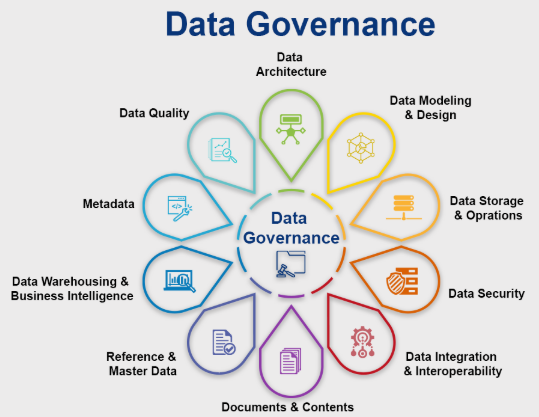
The government platforms (Anjana Data, Collibra, Informatica) focus on the organisational model: domains and responsibilities, policies/SLAs/data contracts, validation workflows and life cycle; they also cover most of the capabilities of catalogues, with a greater focus on business. Conclusion: Categorising is not governing; maturity requires empowering roles, clear processes and trust by design.
A truly operational, business-oriented Data & AI governance
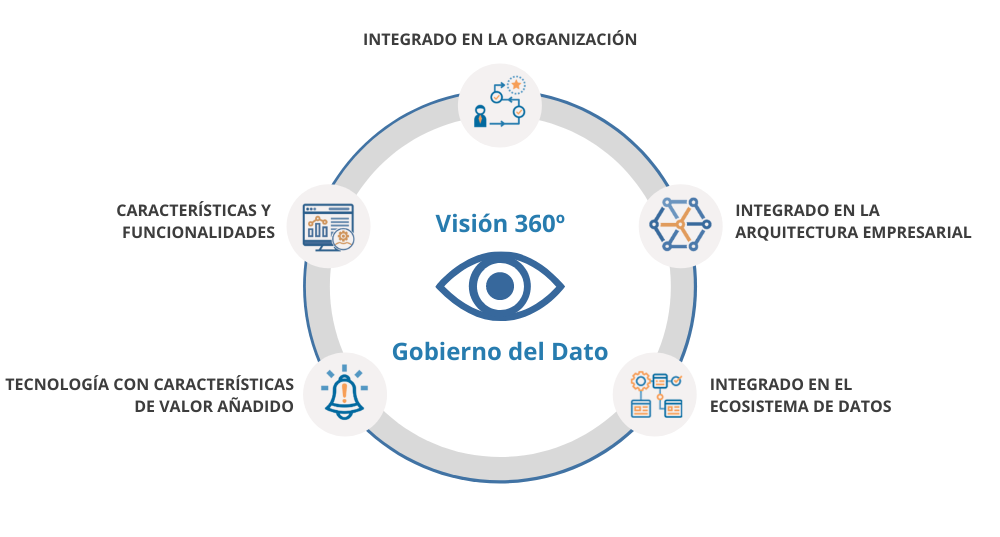
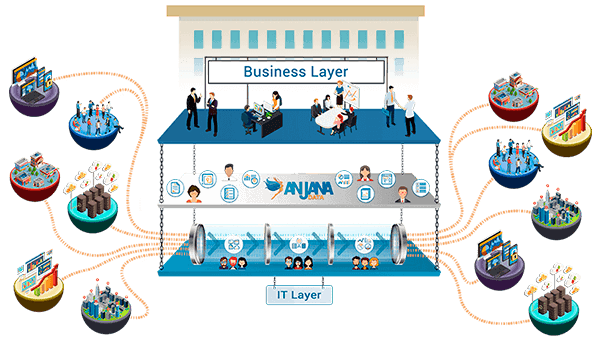
After years of lessons learned in data projects, we have designed a platform to drive data-driven strategies with a 360º government which is integrated into the organisation, the business architecture and the entire data lifecycle. It must adapt to the needs of the business, connecting Business and IT, and become operational with flexible, interoperable and scalable technology that break with the idea that governing is bureaucracy.
We are evolving from the traditional IT-led approach—silos, inefficiencies, quality and risk issues—towards a proactive, preventive and agile government, with data management as products, governed self-service, impact management prior to production y automation of technical processes. The result: reliable data from the design stage, cost reduction through synergies and a cross-cutting data culture.
Anjana Data functions as common layer of governance, metadata-centric, with bidirectional integrations across multiple technologies to support discovery, lineage, access control, auditing, and more. It also accelerates initiatives. DataOps and next-generation architectures (Data Mesh, Data Fabric, Lakehouse) within ecosystems cloud-first, without vendor lock-in and with focus API-first.
Requirements: share data quickly, comply with access policies, and safeguard security/privacy.
Solution: government at the beginning of the value chain, collaborative, integrated with the demand management, with technical automation, iterative by use cases, democratisation y monitoring continue on a Metadata Lake as the backbone of the ecosystem.
Why Anjana Data?
Anjana Data identifies a problem with data management. To address this, it offers technology that starts with a vision, is based on architecture, and is distributed with specific pricing.
Edit Content
Vision
Our Data & AI Government operating model is based on five principles:
Governance-first and shift-left
Governance is applied from the beginning of the data lifecycle to prevent quality, security, and compliance incidents; it is not a subsequent phase or a bureaucratic “gate.” This enables impact control prior to production, comprehensive traceability, and reduced time-to-value in analytical and AI use cases.
Role-based collaborative approach
We define a matrix of domains and roles with explicit functions and responsibilities; permissions are implemented on the platform and dynamically reassigned in the event of organisational changes, avoiding bottlenecks and promoting government federation.
Centralised metadata management, technology-agnostic
A Metadata Lake unifies business, technical, operational, security, and regulatory metadata; from there, we orchestrate active metadata to automate actions (e.g., apply policies, trigger flows, update descriptions or permissions).
Integrated automation and BPM
Workflows and notifications align policies and procedures with demand management, eliminating friction between areas and ensuring evidence of compliance.
Use case-driven iteration and DataOps
Adoption is incremental to capture early ROI, with bidirectional integration into data platforms and CI/CD toolchains to accelerate DataOps, Data Mesh/Fabric, and Lakehouse.
Result:
A government proactive and preventative which adds value to the business, reduces costs through synergies and promotes governed self-service y secure sharing data and models.
Edit Content
Architecture
Modular platform, microservice-oriented and API-first, designed to integrate with hybrid and multi-cloud ecosystems:
Consumer layer and APIs
Fully documented web portals and APIs for all functions; customisation by organisation and role, no black boxes, and accessible repositories for advanced exploitation.
Centralised metadata repository (enterprise-ready)
Open-source base with enterprise layer and accelerators; supports glossary, catalogue, multi-layer lineage, and knowledge graph.
Extended native integration (active governance)
Connectors for metadata and trace extraction, active permission management, external auditing, sampling, and structure management; designed to automate common technical processes from start to finish.
Cloud-first & no lock-in
Agnostic and elastic architecture with native integrations in AWS/Azure/GCP; identity federation and authentication/authorisation delegation with corporate/cloud IAM.
Active Metadata with technical catalogues
Bidirectionality with native cloud catalogues and technical platforms to maintain consistency and assign “master/slave” by functional/technical domain.
Flexible deployment models
On-premises, IaaS/PaaS or SaaS; on VMs or Kubernetes, with options for expansion and customisation of integrations and plugins.
This architecture guarantees decoupling, scalability and operationalisation of government (policies, quality, security, privacy, AI ethics) without sacrificing the productivity of data and business teams.
Edit Content
Pricing
Pay-per-use licensing model with low initial investment and adoption by use cases. Two modalities:
IaaS/PaaS
Licence linked to the number of assets/datasets governed in production; includes unlimited use in two non-production environments, native integrations and plugins, and requires maintenance (Basic or Premium). Deployment on VMs or Kubernetes.
SaaS
Combined licences infrastructure + managed services with levels (Start, Prod, Scale, Grow, Full) according to capacity (governed assets, IAM integrations, plugins). Includes APIs/SDKs, Customer Portal, and associated managed services.
What is included in the licence
End-to-end implementation:
Assessment of architecture, design, production deployment of all services, technical/functional configuration, initial training and first use case to accelerate time-to-market and time-to-value. Adoption is incremental and iterativeYou only pay for what you use and maximise ROI from the outset.
In what areas does technology help me?
Thanks to the flexibility and capabilities of the Anjana Data Platform, our technology can be used in many ways for a wide variety of purposes. That is why we provide our customers and partners with a series of resources and accelerators that can serve as a starting point or reference.
A modern, business-oriented and technology-agnostic approach, implementing governance-first and governance-by-design (shift-left) from the outset of processes. It supports centralised, decentralised, federated or hybrid models, aligned with DAMA-DMBOK, UNE and the Data Governance Act, and designed to operationalise frameworks on a day-to-day basis.
We extend data governance to the lifecycle of AI systems to ensure traceability, transparency, explainability, auditing, and risk management (bias, robustness, drift). We inventory and govern models, data, agents, and APIs, document technical and regulatory evidence, and align with the AI Act (EU), ISO/IEC 42001/22989/23894, and NIST AI RMF to enable responsible innovation.
We centralise and automate processing records and DPIA, natively linked to the corporate catalogue. Risk assessment, validation flows and alerts, breach management and traceability for audits and authorities (GDPR, LOPDGDD, EU DGA, etc.), for proactive and sustainable compliance.
Governance and sharing layer to build interoperable and reliable Data Spaces, with open and extensible architecture, compatible with DSSC and IDSA/GAIA-X frameworks. Data Sharing Agreements and Data Contracts enable secure, sovereign and rule-based exchange from governance (not just from infrastructure).
We have evolved from a Data Marketplace to a Knowledge Marketplace: we manage and publish knowledge products (reports, dashboards, KPIs, models, APIs, pipelines) with responsible parties, purpose and lifecycle, on a Metadata Lake with Active Metadata for recommendations, dynamic policies and automation. It includes DSAs and Data Contracts for regulated exchange and support for standards such as DCAT-AP.
Joint value propositions with other vendors
Depending on the case, the client may require:
One agnostic government platform for your current/future ecosystem.
- Incorporate a Data & AI platform/suite (or specific parts such as virtualisation) more cross-cutting governance. Anjana Data enables both scenarios thanks to strategic alliances y native integrations to deploy integrated architectures.
Cloud & Data Platforms: AWS, Microsoft Azure, Google Cloud Platform, Snowflake, Databricks, Cloudera, Teradata, Oracle, SQL Server.
Virtualisation and Data Management: Determination.
- Integration/BI & others: Qlik-Talend.
Anjana Data provides the layer of governance and sharing agnostic, integrating with catalogues, security, auditing, and native metadata for each piece to consolidate them into a high-level top layer.
Combining architecture AWS, Azure, and GCP, Traditional DWH (Oracle/SQL Server/Teradata), On-premises data lake with Cloudera, cloud platforms (Snowflake/Databricks) and virtualisation with Denodo; everything governed by Anjana Data taking advantage of native integrations and maintaining governance decoupled from the underlying technology.
In groups/holdings with multiple organisations (different architectures, operating models, and domains):
A single multi-tenant instanceCentralised licensing and operation, less complex deployment, but less technological/functional independence per organisation.
Several federated instances: maximum autonomy per organisation (configuration, evolution, compliance), with the possibility of higher authority“ for global vision and federation mechanisms.
The joint strategy enables:
- Cross-cutting government stable and portable even if technologies change.
Use of native capabilities (metadata, security, auditing) for each platform without duplicating or rewriting, elevating them to a common layer of government.
- Time-to-value accelerated, lower lock-in risk and alignment with federated models (Data Mesh, Data Spaces), maintaining governance as guiding principle.
Value-added services included
Full access to:
- Guides and documentation for User, Installation, Operation, Administration, and Configuration.
- Documentation of technical architecture and platform technologies.
- APIs and SDKs (reference and examples).
- Integration manuals with third parties.
- Notes from versions and updates.
- Documentation of licences, prices, support y professional services.
- Restricted content: use cases, webinars y white papers.
Specific information for partners.
Anjana Data Certification with itineraries by role:
- Administrator
- Platform
- User
- 24/7 ticket creation in the support tool.
- Unlimited open tickets.
- TOR (Response Time) max. 1.2 hours for categorising new tickets.
- TOA (Response time) max. 24 hours for the first update with resolution notification.
Ticket types: Hotfix, Configuration, Error (Bug), General support, Roadmap request.
What are you taking with you? Anjana Data
01
Government by design integrated into processes and demand, with workflows and automation of controls.
02
Unified governance layer for hybrid and multi-cloud ecosystems, without vendor lock-in.
03
Pragmatic execution: use cases with tangible returns and iterative adoption.
04
Through joint value propositions, we bring that governance to Data Fabric and multi-cloud architectures with leading vendors, keeping the governance layer agnostic and maximising the capabilities of each piece of the stack.