
Identified needs
Lanbide, the Basque Employment Service, has set itself the goal of ensuring the transparent, ethical and secure use of Artificial Intelligence (AI) in its business processes and decision-making. In a context of increasing regulation and with citizens becoming increasingly demanding in terms of digital trust, the organisation required a comprehensive approach to ensure regulatory compliance and consolidate credibility in the use of AI in the public sector.
To achieve this, Lanbide had to overcome several key challenges:
- Regulatory compliance and strategic alignment: Adapt to EU Artificial Intelligence Regulation (AI Act) and the Data Governance Strategy of the Autonomous Community of the Basque Country (CAE), guaranteeing a framework for action in accordance with European and regional regulations.
- Algorithmic risk management and mitigationImplement effective mechanisms to identify, assess and mitigate risks associated with the use of AI models, ensuring their reliability and minimising unwanted biases.
- Transparency and accountability: Develop a governed inventory of the algorithms used both in the Administration and in private entities that provide public services, enabling supervision, auditing and traceability.
- Ethics and fundamental rights: Integrate the use of AI within an ethical framework that guarantees security, respect for fundamental rights and non-discrimination, avoiding adverse impacts on society.
In this context, Lanbide identified the need for a platform specialising in data governance and AI that would enable it to efficiently record, manage and govern their algorithmic models. The goal was to ensure responsible use of technology, optimise operational processes, and consolidate governance that aligned the use of AI with the principles of transparency and control.
Before expanding its scope to artificial intelligence, Lanbide had already developed a solid foundation in data governance, implemented on the Anjana Data Platform, with the following key capabilities:
- Operational model based on roles and permissions: Clear definition of responsibilities through validation flows aligned with RACI matrices and the DAMA-DMBOK2 philosophy, ensuring the custody and traceability of data and information assets.
- Data and information asset cataloguen: Structured inventory covering datasets, reports, indicators, dimensions, business rules and quality, providing an orderly framework for metadata management and governance.
- Unified Business GlossaryA common language within the organisation that facilitates the understanding, interpretation and use of data in different areas of the entity.
- Data traceability and lineageMechanisms for tracking data from its source to its final consumption, ensuring transparency, auditability, and trust in the information used.
All these capabilities, already operational on the Anjana Data Platform, have provided Lanbide with a mature foundation to evolve towards the AI governance. The platform, in addition to managing the data governance, offers advanced functionalities for recording, auditing, and controlling algorithmic models, ensuring their alignment with the principles of ethics, transparency, and regulatory compliance.
Thanks to this technological continuity, Lanbide can integrate AI governance into an already consolidated environment, optimising efforts and ensuring a unified approach to data management and artificial intelligence.
Current and future architecture
Currently, the Anjana Data Platform instances at Lanbide are deployed on-premises on the EJIE (Basque Government IT Society) infrastructure. These instances are integrated with the operational data stored in the ODS and DWH, both based on technology. Oracle, as well as with the views of Hive of EJIE's BDaaS (Big Data as a Service) platform, which operates on technology Cloudera.
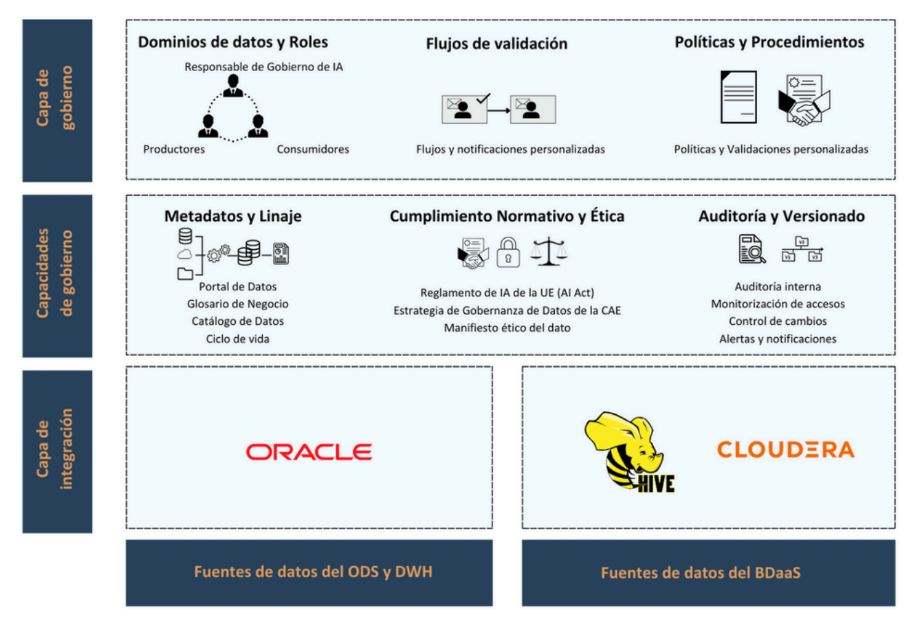
EJIE is in the process of migrating its BDaaS architecture in Cloudera to a new infrastructure in AWS, known as BatData. In this context, work is already underway on deploying plugins for integration with the Anjana Data Platform and integrating with the identity management system, thus ensuring the continuity and evolution of data governance in this new technological ecosystem.

Given that EJIE is committed to a strategy focused on AWS, The possibility of migrating the current on-premises infrastructure of the Anjana Data Platform to a SaaS model through the AWS marketplace. This option would optimise platform management, reduce operating costs and increase the flexibility and scalability of the service.
Use case
Lanbide seeks to lead AI governance in the public sector with an innovative approach that goes beyond traditional practices by:
- AI-governed inventory: Integrated with the data governance platform for precise control of models and data.
- Continuous updating: Surpassing the CAE catalogue, which lacks proactive mechanisms.
- Advanced search and traceability: Structured navigation with detailed filters between models, data, and reports.
- Structured operating model: Definition of roles and validations to ensure quality and regulatory compliance.
Methodology
Lanbide has extended its Data Governance strategy to AI, leveraging the infrastructure deployed with Anjana Data Platform. For AI governance, improvements were added such as:
- Extension of the metamodelCreation of the entity «AI System».
- Structured metadata templates: Documentation on purpose, responsible parties, data sources, ethics, risks, and auditing.
- New role: «Head of AI Systems»: Specific permissions for comprehensive governance.
Inventory of AI systems
As a result, Lanbide has developed a governed AI inventory, highlighting the Careers and Skills Assistant, which analyses employment demand using statistical profiling and predictive models.
This inventory ensures traceability, supervision efficient and alignment with European regulations and guidelines of the Basque Government, establishing a standard that can be replicated in other public sector institutions.
Objectives set
To respond to these challenges, Lanbide has defined the following strategic objectives:
- Implement a robust AI governance framework, aligned with the principles of the CAE Public Sector Data Ethics Manifesto, promoting the safe and equitable use of algorithms.
- Deploy a governed inventory of algorithmic models and AI systems, which guarantees the traceability, auditing and supervision of all systems used in its business processes.
- Support the public registration of algorithms and AI systems, in line with the Basque Parliament's initiative to strengthen transparency and accountability.
- Ensuring compliance with the EU AI Regulation (AI Act), evaluating existing models and ensuring their compliance with regulations before the effective date.
- Promote awareness and training on AI in the Administration, training internal teams in the responsible use of technology and promoting informed decision-making.
- Serve as a reference for other public administrations, sharing Lanbide's experience and contributing to the development of data governance and AI policies in Spain.
This project not only responds to a regulatory requirement, but also positions Lanbide as a benchmark in the ethical and efficient management of data governance and AI systems in the public sector, laying the foundations for a future where artificial intelligence enhances the quality of public services without compromising public trust.
Benefits obtained
Lanbide's Governed Inventory of AI Algorithms and Systems offers key improvements over the CAE Catalogue, ensuring standardisation, continuous updating, greater searchability and a robust operating model, all within the data and AI governance platform:
- Standardisation and homogenisation of documentation using structured templates with validations, avoiding inconsistencies and ensuring regulatory alignment. Unlike the CAE PDF, which is based on free text, the Lanbide inventory uses preconfigured metadata, facilitating governance.
- Always up-to-date and reliable information. While the CAE Catalogue does not automatically update data (e.g. managers of models that are no longer in use), the Lanbide inventory guarantees accurate, real-time information.
- Advanced search and browsing capabilities, More powerful than the CAE catalogue, which only allows searches by text, subject and organisation, the Lanbide catalogue allows filtering by any attribute and browsing from datasets, reports or business terms, facilitating access to relevant information.
- Operational model with governance and control, thanks to the definition of roles, validation flows and traceability to ensure effective oversight of AI models.
- Comprehensive governance of the model and the data it consumes. Not only are AI models governed, but also the data that feeds them, helping to detect and mitigate biases at source.
With this initiative, Lanbide has not only incorporated an AI governance model aligned with European regulations, but has also demonstrated how artificial intelligence can be integrated ethically, safely and effectively into public services. This project is not just an operational improvement, but a paradigm shift in data management and AI in the public sector, setting a precedent for other institutions in Spain and Europe.
Challenges overcome
The implementation of the Governed Inventory of AI Algorithms and Systems at Lanbide has required overcoming various technical and organisational challenges:
- Fragmentation and heterogeneity of documentation: We moved from unstructured formats that were difficult to maintain to a standardised system with templates and validations.
- Outdated informationA continuous updating mechanism was established to ensure accurate, real-time data.
- Difficulty in traceability and auditingAn operational model was implemented with roles, validation flows, and traceability, ensuring effective supervision.
- Regulatory compliance and adaptation to the AI ActA thorough analysis of existing models was carried out to bring them into line with European regulations before they came into force.
- Internal awareness-raising and trainingStaff training in the responsible use of AI was promoted, fostering a culture of data governance and artificial intelligence within the organisation.
By overcoming these challenges, Lanbide has managed to consolidate a robust AI governance framework, ensuring transparency, fairness and efficiency in its processes.
Time spent
The implementation of the Governed Inventory of AI Algorithms and Systems at Lanbide has been carried out in a reduced time, thanks to the combination of a well-defined governance methodology, support for partners specialised tools and the agility of the Anjana Data platform.
Although the technical setup was quick, most of the effort was focused on the dDefinition of a robust operating model, aligned with the principles of transparency, traceability y regulatory compliance.
In addition to a well-structured strategy, another key factor in the project's success has been the collaboration with partners specialised and certified in Anjana Data Platform, such as Telephone company y Decision date, who have contributed their experience in implementing data governance and AI strategies. Lanbide has also received advice from Gartner, which has enabled us to adopt an approach aligned with best practices in the sector and opt for a niche platform. recognised in the Magic Quadrant for Data & Analytics Governance Platforms.
The breakdown of times reflects this reality:
- Methodological design and alignment with regulatory frameworks: Significant time has been invested in analysing best practices, identifying roles, and structuring the lineage of AI models.
- Anjana Data Platform ConfigurationApproximately 8 hours, including the creation of the governance model, metadata configuration, and definition of relationships for traceability.
- Gathering information on models and sourcesApproximately 8 hours, consolidating data on algorithms in use, training datasets, and associated processes.
- Data loading and validationAlso 8 hours, covering model cataloguing, dataset documentation, and data lineage construction.
Currently, 20 users have access to the platform, with the capacity to scale to more than 1.000 empleados/as de Lanbide.
Estos tiempos demuestran que, cuando se combinan una estrategia bien definida, el apoyo de partners especializados, la visión de consultoras líderes como Gartner y la elección de una plataforma avanzada y reconocida en el sector, es posible un despliegue ágil y eficiente sin comprometer la calidad ni la solidez del gobierno de la IA.