
Identified needs
The Data Office of Osakidetza, the Basque Country's public health service, has identified the need for a platform to govern data due to the growing volume of data being managed and the quest to improve decision-making and the quality of healthcare services by harnessing the potential of Big Data:
- The client needs to define a Data Governance Model that guarantees the availability, integrity, usability, and security of the data used, ensuring that the information is efficient and operational for decision-making and improving healthcare services.
- The Data Governance Platform must enable the implementation of use cases with Big Data technology, which validate and implement the defined model, demonstrating its suitability in practice and allowing for the necessary adjustments for its optimisation.
Use case
The use case has been proposed based on an initial model designed for governance purposes. From the outset, the two strands of the project consist of the development of two analytics use cases with Big Data technologies carried out by the integrator Telefónica Tech.
This initial definition of the data governance model has been based mainly on:
- Business aspects: A governance model and a fully customised business glossary have been developed for Osakidetza and implemented in Anjana Data thanks to the platform's configuration capabilities and flexibility. In addition, the model has focused on the business areas involved in analytical use cases, which are:
- Nursing Care
- Medical History
- Pharmacy.
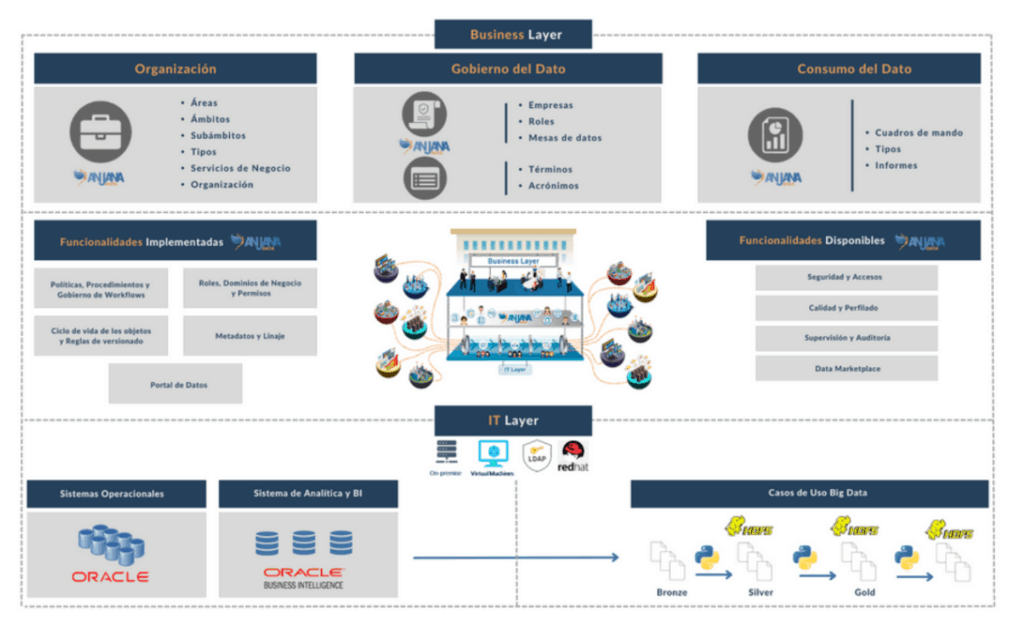
- Technical aspects: We have worked alongside Osakidetza's IT department to identify the necessary configuration in Anjana Data to host technical metadata. In addition, the data catalogue has been created and populated with both native platform entities and customised entities and relationships for Osakidetza. One example of this is the use cases for analytics, which have been designed to identify the end-to-end data lineage through the use cases.
Objectives set
The main objective is to establish a Data Governance framework that guarantees the availability, quality, security and efficient use of customer information. This includes defining an organisational model for Data and Analytics, establishing data quality and security standards, managing data architecture, controlling data quality and consistency, and establishing policies and procedures.
This objective is based on establishing an initial governance approach and an initial metamodel at Anjana Data.
Once the Data Governance Model has been defined, its suitability will be validated by developing two use cases in the field of Big Data. These use cases include identifying the origin of the data, defining principles and procedures, establishing an organisational model, managing cultural change, delivering the results of the use cases, and creating a scorecard and a document repository. The entire development of these cases will be implemented in Anjana Data, including the metadata necessary for their governance.
The objective has been set to have two initial Big Data use cases that arise in a governed manner:
- Use case 1: Intervention model comparator.
- Use case 2: Optimisation of the active labour identifier model.
Anjana Data can be used to view data sources and the transformations they undergo throughout the development of use cases, such as the persistence of final data. All of this is done using both native entities offered by the solution itself and entities and relationships configured for the Osakidetza context.
Functional and technical architecture
Benefits obtained
Thanks to the joint efforts of the various stakeholders, Osakidetza now has the necessary knowledge, a governance platform and established guidelines to continue with the Data Governance initiative.
Throughout the development of the definition, there has been collaboration between Osakidetza staff, EJIE (Basque Government IT Society) staff and the integrator Telefónica Tech to conclude with an effective transfer of knowledge, operations and management that has enabled the target stakeholders to achieve a sufficient degree of autonomy to continue with the implementation of more data governance use cases.
The Basque Country Public Health Service has an initial metamodel with business and technical entities that reflect what was gathered during the first year of the project.
During the configuration and implementation phases of governance metadata and use cases, we worked closely with the Osakidetza Data Office, which has grown in terms of personnel and provided these individuals with Anjana Data Official Certification for training. In addition to this training, support was also provided by Anjana Data's Customer Success team. As a result, Osakidetza staff manage the platform independently, taking responsibility for ensuring the integrity of the metadata that reflects data management through the two use cases and the governance model defined during the project.
Challenges overcome
Each phase has involved a series of challenges which, first by the project team and ultimately by Osakidetza, have been overcome throughout the development process with a shared focus on achieving the aforementioned objectives.
- Definition phase of the governance model:
- The initial project team faced the major challenge of establishing an initial information governance model scenario, but thanks to the dedication of both the integrator and the staff at Osakidetza and EJIE, consensus was reached and a framework was established that made it possible to define the concepts, resulting in the governance metamodel currently in place at Anjana Data. One example of this is involving the areas whose data is being analysed in the use cases.
- On a more technical level, both the Telefónica Tech integration team and the Anjana team have focused their efforts on translating the findings into the Anjana Data configuration to make the most of the platform's features, respecting the definitions in the data tables and generating an operational framework that can accommodate all the technical and functional metadata for the use cases.
- Production launch and implementation of use cases: During this phase, the main challenges are divided into technical, functional, and operational:
- Technicians: Initially, the source data systems were set up, integrating information from the operational system databases using plugins. However, after reviewing the use cases and changing the scope, it was decided to include the technical lineage from the OBIEE data centraliser, deploying more plugins for this purpose and retrieving the metadata from this system's databases.
- Functional: Following the initial definition of the governance model and operational framework for use cases, modifications and decisions have been made as these same use cases have progressed. And thanks to Anjana Data's configuration and customisation capabilities, it has been possible to change the metamodel and configuration in order to offer, through the platform, the most optimal associated metadata, thus ensuring the success of the governance initiative in this first phase.
- Operations: following completion of the project, both technical and functional management of the platform has been transferred to Osakidetza and EJIE. This has required defining the operations to be carried out, as well as workshops and close collaboration between Anjana Data's Customer Success team, the Osakidetza Government office and designated EJIE staff. All this was achieved thanks to a series of workshops on deployment, configuration and interventions, which served as the lever for achieving autonomy in the management of the Anjana Data platform in all its aspects.