
Anjana Data's data governance solution releases its new version with new features
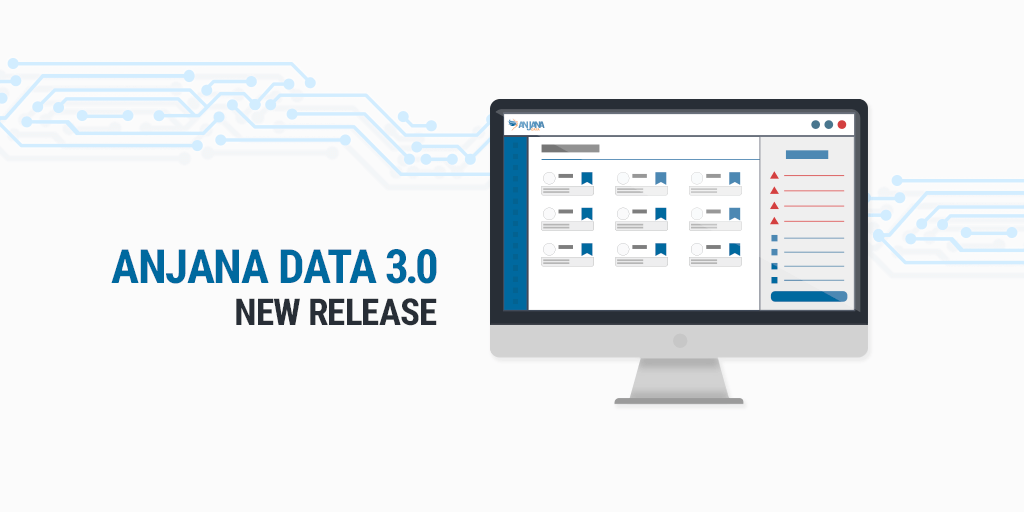
Anjana Data releases a new version, 3.0, which includes a new generation Business Glossary, flexible and customisable, fully integrated over Data Catalog and an evolved CORE metamodel. It also incorporates new workflow management mechanisms, dashboarding and reporting tools, AI & ML-based assistance pills and technical improvements within its entire microservices architecture.
Anjana Data is a unique and distinctive Data Governance solution, based on cutting-edge and consolidated open-source technologies, designed to assist organisations in implementing their data strategy roadmap in the era of Big Data, Multi-Cloud and Data-Driven.
Its release 3.0, which will be available from the second week of April, brings an update of improvements and additional features such as the integration of a fully flexible and customisable next generation Business Glossary integrated over Anjana Data Catalog to help build a common language and a single semantic layer across the entire organisation.
The solution also integrates a new built-in BPM for validation workflows based on Activitiesi, offering the possibility of improving management, performance and capabilities in the automation of procedures and data governance processes.
In addition, this version 3.0 of Anjana Data includes the integration of self-service dashboarding and reporting tools that facilitate data governance implementation control and follow-up through the integration of open-source solutions. Grafana and Hue in the technology stack.
With this launch, Anjana Data intends to continue with the unstoppable growth of the first quarter of the year., «We are very pleased not only with the welcome our vision is receiving in the market, but also with the performance of the team that is making it possible for that vision to be realised in the solution release after release. The feedback we are receiving from our clients is very positive and it inspires us to continue along these lines.», said Mario de Francisco, Chief Executive Officer of Anjana Data.
Ana Melcón, Head of Product & Development, also quotes: “At Anjana Data, we are a multidisciplinary team working side by side with our customers, and we are constantly setting ourselves new challenges and goals. That fact forces us to move forward and keep adding new features to expand the solution's coverage in order to maintain the level of innovation that the market needs.”.
Next-Generation Business Glossary
Anjana Data’s Business Glossary is based on three main objects: containers, terms and relations; each one with their own flexible and customisable attributes based on dynamic generation of templates and forms. The flexibility of this design gives organisations the ability to model their semantic reality, easily managing ontologies, taxonomies and exceptions, providing a pure business vision.
This Business Glossary will be fully synchronised automatically and supported by the CORE metamodel to offer users the possibility to seamlessly perform a complete journey through data, both top-down and bottom-up. With this feature in place, it will be possible to easily move from the business vision to the technical point of view and vice versa from any place in the solution by combining both worlds.
Other new features included in Anjana Data's Business Glossaryand are:
- Advanced search engine and terms dictionary to easily find what you are looking for.
- Flexible roles-based governance model for terms and relations management and maintenance along with customisable validation workflows.
- Pre-defined controls to guarantee uniqueness, consistency, and integrity of business terms.
- Crowdsourcing data assets in order to create actionable knowledge based on governed data.
- The alerts and notifications module is integrated to enhance stakeholder collaboration and interaction under an advanced UI and UX.
- Incorporation of user assistance capabilities and support for manual tasks based on advanced analytical algorithms, Artificial Intelligence and Machine Learning for a better user experience.
New built-in BPM for validation workflows
Process management becomes faster and more intuitive with Anjana Data and the integration of Activiti, an open-source workflow engine written in Java that can execute business processes described in BPMN 2.0. This integration improves the management, performance, and capabilities of approval workflows.
This version also includes basic features that cover the same capabilities included in Anjana Data v2.0 but extended to the new Business Glossary module. The incorporation of Activiti The integration of this technology into the technology stack gives Anjana Data the possibility to easily offer extended features for validation workflows in the near future, along with a new experience for workflow design, customisation, and management.
Additional new features in release 3.0 of Anjana Data include:
Dashboarding and reporting
An important added value in this release 3.0 of Anjana Data is the integration of the self-service dashboarding and reporting tools., Grafana and Hue, which facilitate the control and monitoring of the implementation of the Data Governance model in the Organisation, from Anjana Data.
Grafana allows the user to query, visualise, alert and graphically display activity within Anjana Data in a simple and attractive way, even in real time, and is particularly suitable for presenting information in timelines. On the other hand, Hue, provides the best metadata (hosted in Anjana Data) querying experience in a quick and easy way with the most intelligent autocomplete capabilities, query sharing, charts, dashboards, and downloading tools. All this without programming because the analysis is done dynamically by clicks and drag and drops.
These tools included in this new reporting and dashboarding module give solution users the possibility to easily create and share their own dashboards and reports from stored data in Anjana Data’s internal repositories.
Data Catalogue and Data Lineage
In addition to the above improvements, the new release of Anjana Data extends its CORE metamodel with additional metadata to provide greater context and insight into the data while making their governance easier. As an important improvement, taxonomies and custom metadata can now be added at field level.
In relation to data lineage features, the possibility of adding detailed functions at field level when declaring or importing processes and instances into the metamodel is included. In this way, the option to drill down from the object level to the field level is allowed to have a granular view of the data movement. In addition, in the extended data lineage visualisation, the information regarding the users adhering to the DSAs has also been expanded (Name, Role, Business Unit, etc.).
Back-end improvements
Finally, various improvements at the technical level have also been included to further ensure the scalability, interoperability and ease of use of the solution:
- Public API 3.0 with extended features and improved capabilities and administrative API 1.5 totally independent from the Public API for administration purposes.
- New OAuth-based authentication that enables seamless integration with a multitude of identity management systems.
- Refactoring code for performance enhancement and software quality improvement:
- Management of roles and privileges
- Indexación dinámica de objetos dentro del Portal de datos
- Management of the execution steps within approval workflows
To request a demonstration of the Anjana Data solution, please click here.
Additional resources:
- For further information about Anjana Data, download our brochure.
- Check out what's new on LinkedIn and Twitter.
About Anjana Data:
Anjana Data was founded in Madrid in 2019 as a product-oriented company to develop, support and market its own innovative and disruptive data governance solution. Anjana Data is not just a data governance tool; it is the implementation of a philosophy resulting from extensive experience in data-related projects.