Anjana Data Platform Features
Data Governance & Agnostic AI Platform, operable and scalable in cloud, on-premises, hybrid, and distributed/federated environments. Modular, no-code/low-code architecture that aligns the operating model with organisational charts, domains, and processes without being tied to stacks.
Operationalisation of the governance model
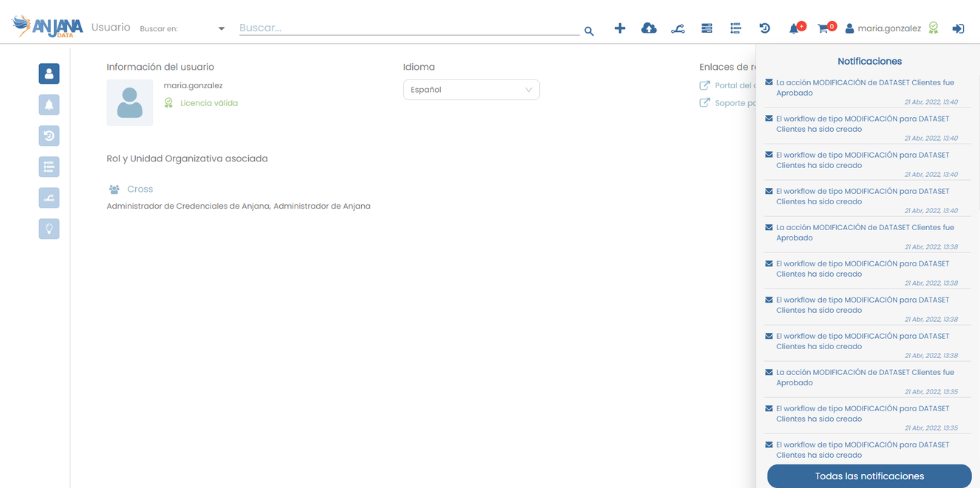
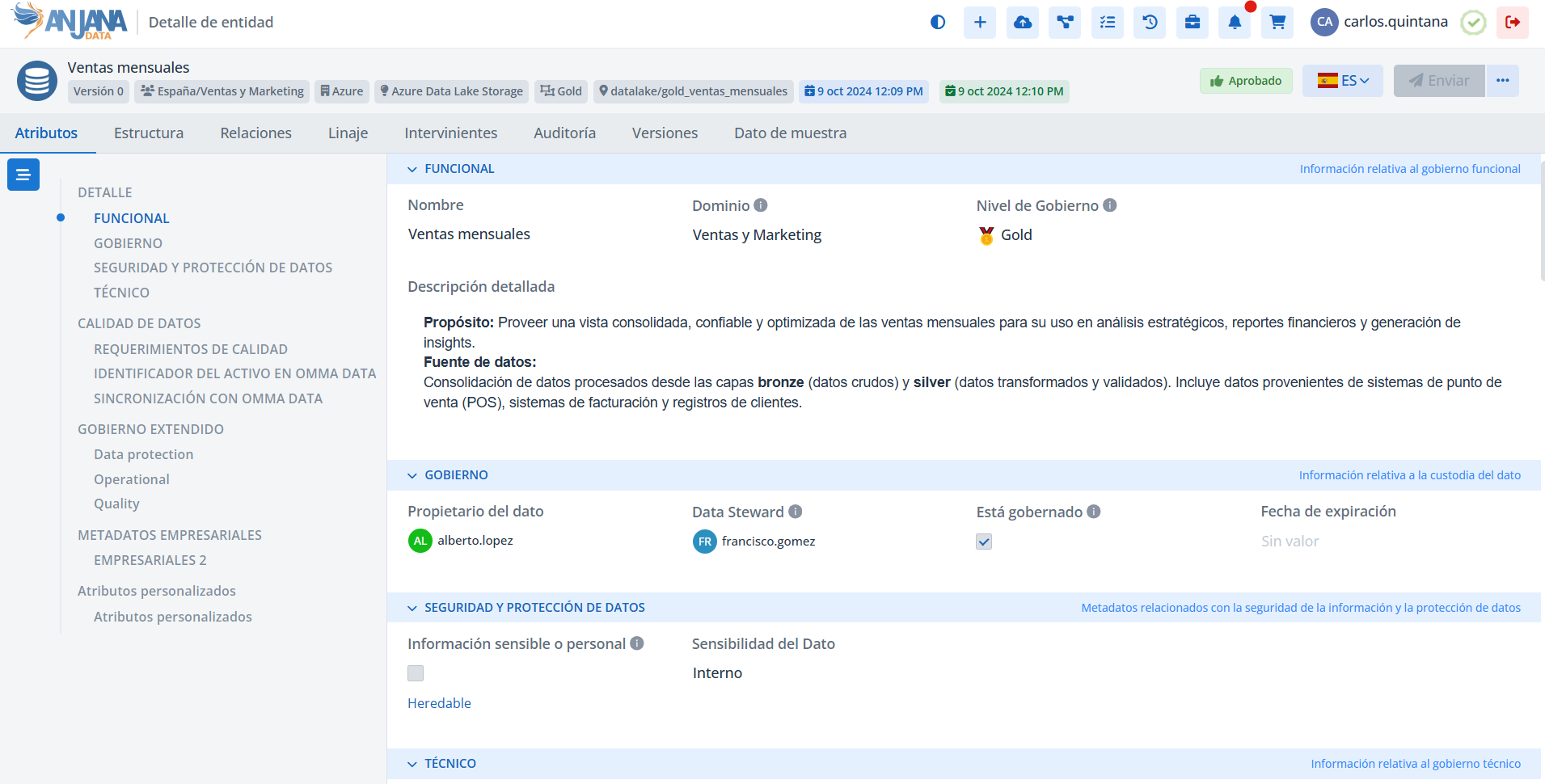
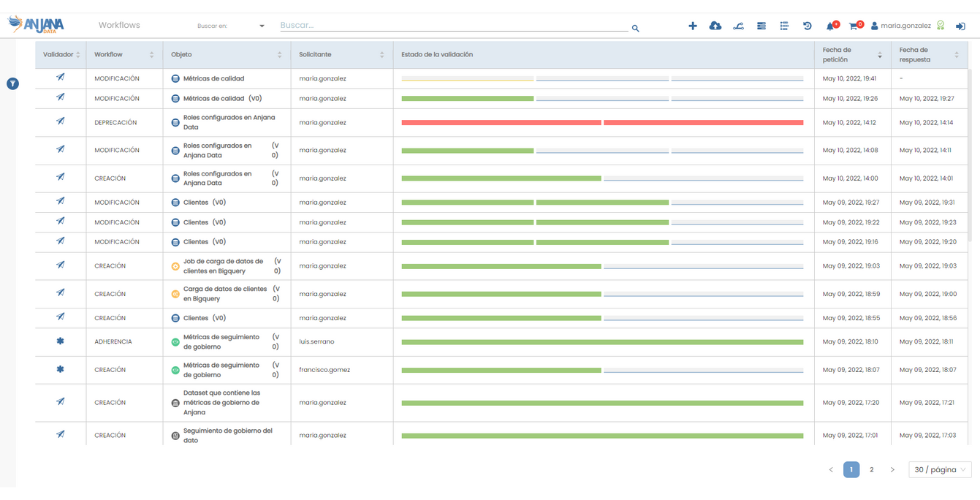
Configure domains, roles, and permissions to implement centralised/decentralised/federated models, with a roles×domains matrix that decouples functions, maintains traceability, and propagates capabilities in a multi-level/multi-domain approach. An integrated BPM orchestrates approvals/notifications by role and applies policies on the metamodel lifecycle (states, transitions, validations), with integrable notifications (e.g., email) under governance-first/by-design principles.
Business glossary and unified semantics
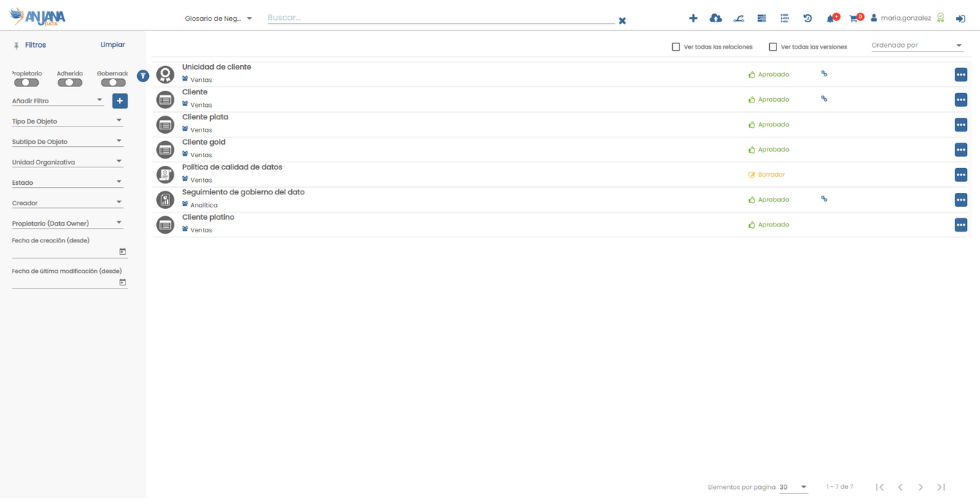
The Business Glossary It acts as a higher semantic layer, synchronised with the global metamodel, to describe concepts, entities, and relationships from a business perspective, with flexible attributes and bidirectional navigation with the catalogue. It operates in a collaborative, multi-language environment, customisable by user, and facilitates semantic searches and contextualised access to organisational knowledge.
Centralised metadata catalogue and management
Metadata Lake that consolidates metadata (technical, functional, operational, social, regulatory) in an open repository via API; automates discovery and lineage at the field level, integrates cloud catalogues, and injects metadata (Active Metadata) to trigger policies/controls in external systems. Active management that captures/generates metadata (technical and business) and orchestrates actions on assets, enabling governance-first DataOps environments throughout the value chain.
Hybrid, global and multi-layered lineage
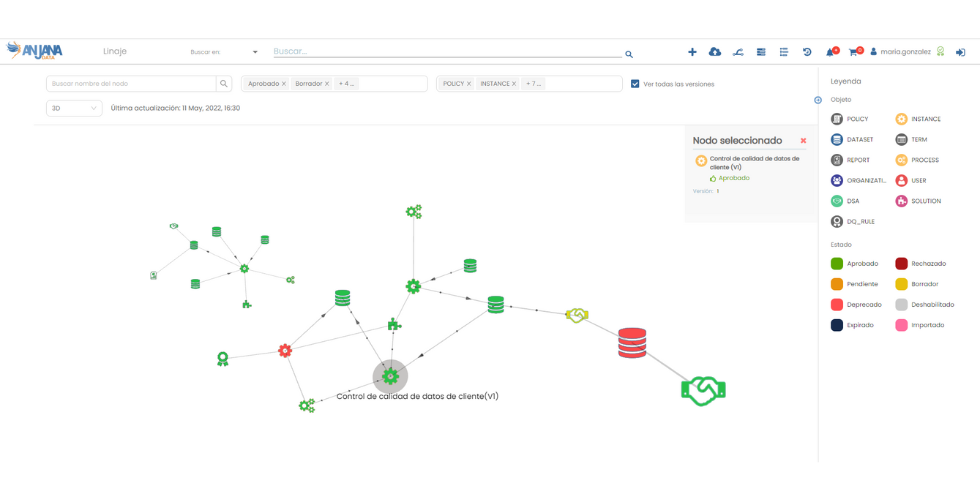
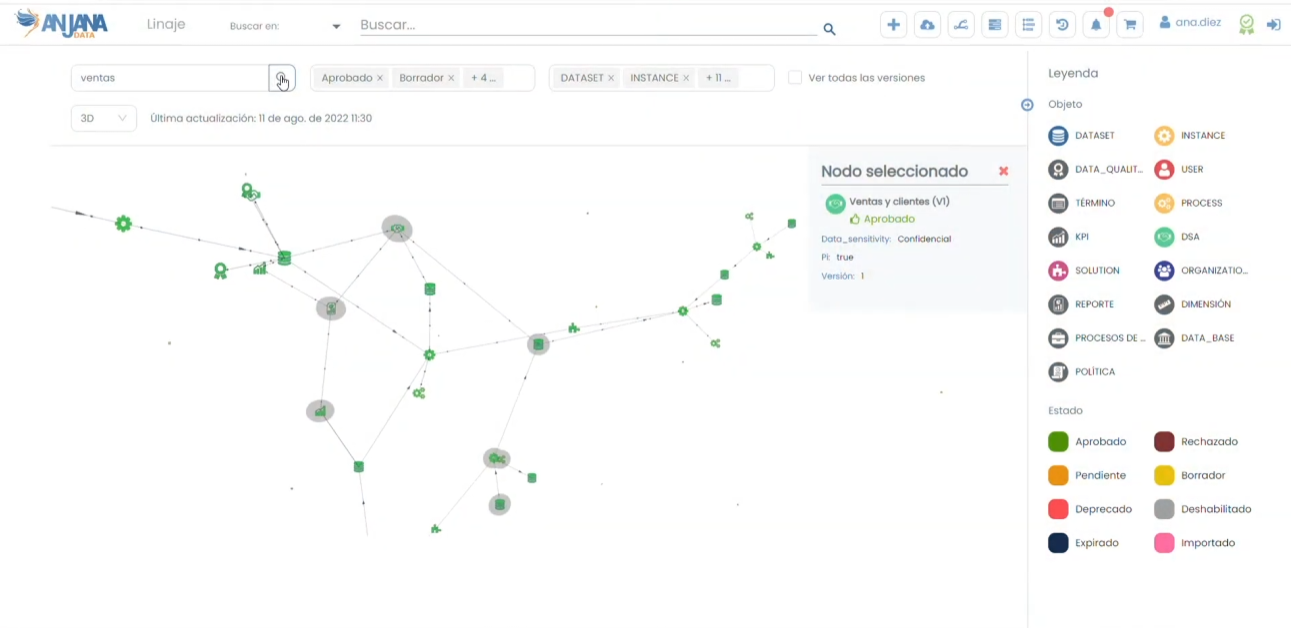
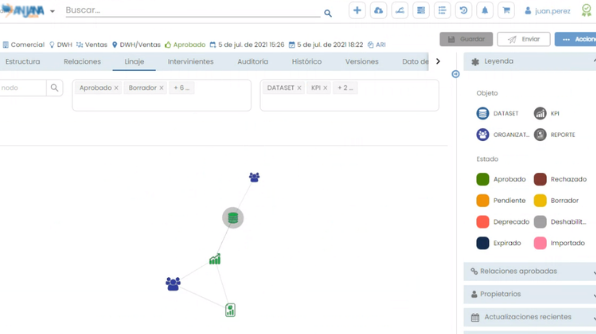
The extended lineage offers end-to-end traceability both vertically (technical→business) and horizontally (origin→consumption), with multiple configurable visual layers by user profile. This vision underpins the impact control Proactive: before propagating changes, dependencies are identified, relationships are evaluated, and impacts are communicated to make informed decisions. The platform incorporates automatic impact detection., advanced versioning, expiry management and comparison of objects to prevent degradation and mitigate unapproved errors.
Active governance, permissions, and auditing
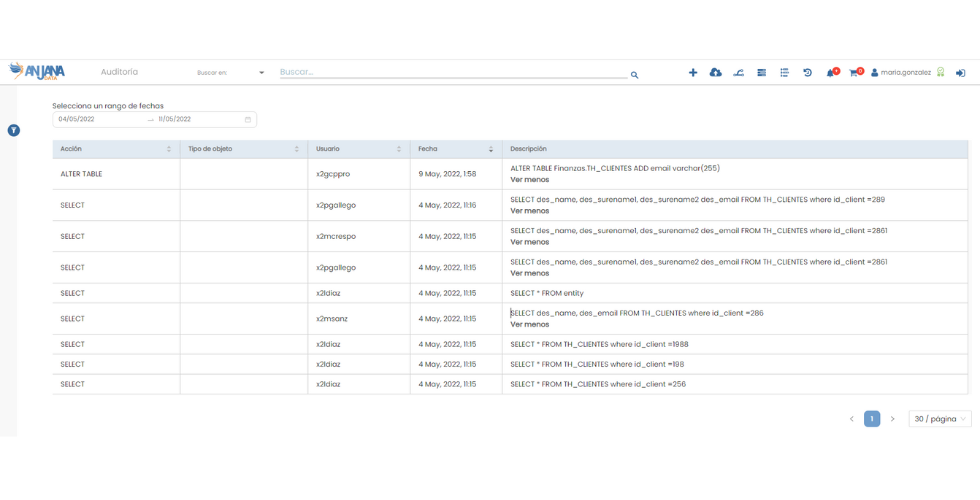
Anjana Data delegate authentication and/or authorisation in corporate IAM (LDAP, cloud providers) or will manage these aspects locally when necessary. The access permission management natively integrates with identity systems and storage/consumption/virtualisation technologies to offer a marketplace experience complete and automated. Every user action on governed assets is audited (via UI, API or programmatically), with version history and external audit collection (accesses, transformations, executions) through passive communication mechanisms.
Data quality and indicators
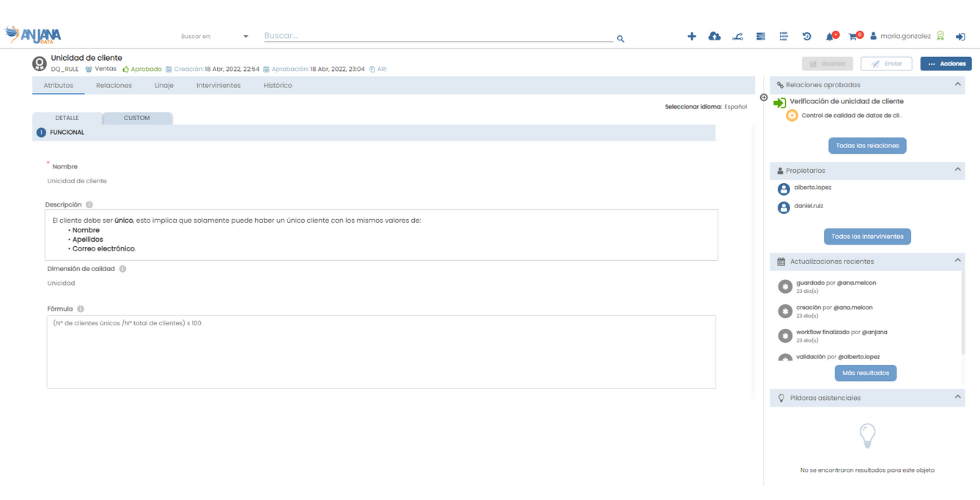
The platform manages quality rules and controls in an open and customisable way, integrating with third-party quality engines for execution. It allows you to define metrics associated with assets and consolidate results with different levels of granularity for analysis, monitoring, warnings and monitoring of preventive/corrective actions, positioning Anjana Data as supervisory layer quality within the framework of governance.
Information Portal and Marketplace
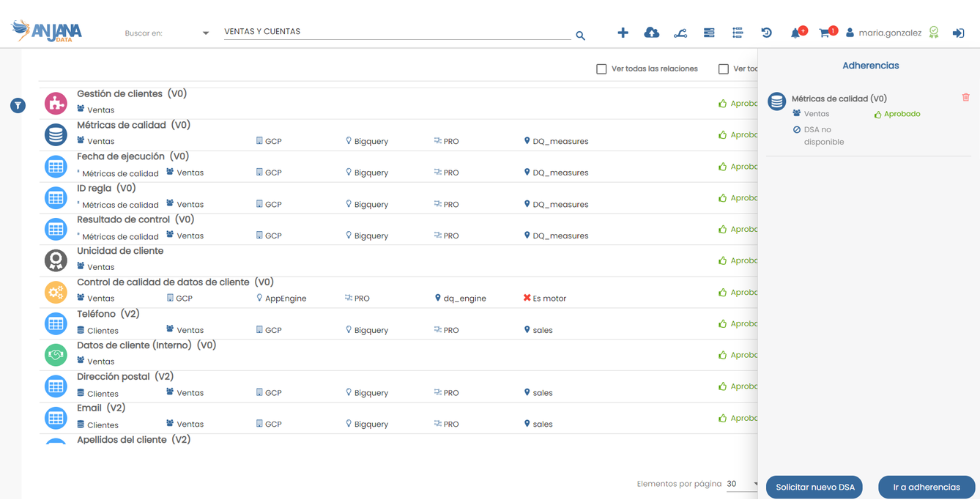
Information portal with semantic search in natural language, dynamic filters, rankings, and saved searches on the Metadata Lake. Marketplace that publishes Data/AI Products, manages consumption via DSAs and Contracts, request “cart,” approval flows, and automatic permission granting, with an obfuscated sample option to validate fitness-for-use without moving/replicating data.
End-to-end integrations and automation
Interoperability is a design principle: the platform integrates with catalogues and stacks from leading suppliers for metadata extraction, sampling, active government (permission management, labelling, actions) and observability. Communication bidirectional with technical catalogues enables architecture Active Metadata in which the functional government layer enriches the catalogues and vice versa, avoiding friction, vendor lock-in and misalignments between business and technology.
Monitoring, reporting and exploitation of the government itself
All internal repositories at Anjana Data are open and documented, allowing tools to be connected Business Intelligence/Analytics to monitor the adoption of the governance model, process performance, quality and compliance status, or the degree of asset reuse. This enables KPIs and SLAs governance and accelerates continuous improvement with quantitative evidence.
User experience, scalability, and customisation
The user experience is designed for non-technical profiles, with simple and intuitive interfaces and role-based experiences, backed by Training Portal and certifications. The scalability technical (Big Data architecture with horizontal scaling) and functional (configurable modules) allows organisational and regulatory developments to be supported without traumatic redesigns. The customisation covers metamodels, templates, flows, notifications, translations, and corporate branding.
Security, compliance, and regulatory auditing
Anjana Data is enterprise-ready and complies with standards such as ENS; integrates internal and external audit evidence, captures user actions, and retains change history to support regulatory compliance y forensic readiness. This approach facilitates alignment with frameworks such as LADY, specifications UNE Government/Data Quality, and even initiatives for AI Governance (model lifecycle management, evidence for AI Act), when the corresponding use cases are deployed.