
Webinar Summary: Data Governance 2.0, Data Stewardship & Privacy: Best Practices to Operationalise Data Strategy
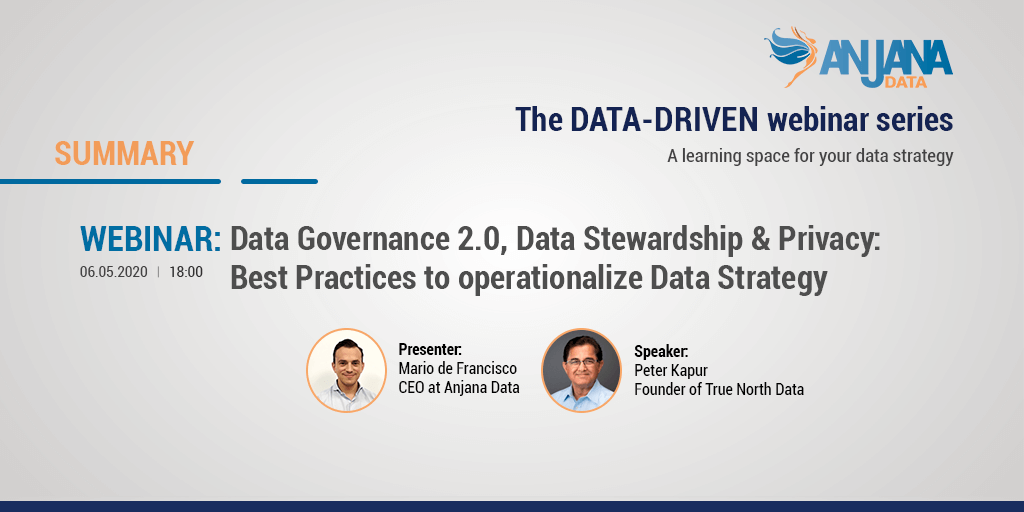
On 6 May 2020 Mario de Francisco, CEO at Anjana Data presented Peter Kapur, Founder of True North Data. Together delivered the second webinar in the series “The DATA-DRIVEN webinar series”.
In this webinar Data Governance 2.0, Data Stewardship & Privacy: Best Practices to Operationalise Data Strategy, Peter Kapur discussed re-imagining Data Governance from the 2008 Crisis to the opportunity of Data Monetisation and Revenue Optimisation. Here are some of the main points:
-
- Data Governance – Historically, has focused on Compliance and Regulations.
- Data Governance 1.0 came to prominence in the aftermath of the financial crisis to satisfy regulators for financial data certification (BCBS 239, Sarbanes–Oxley).
- Frameworks were created embedding governance components (DAMA, DMBOK). Assessments/checklists were created (DCAM, DMM). Privacy and data protection were added to the framework to continue the compliance and defence path.
- Data Governance 1.0 framework with policies and procedures was used across industries, even those not directly impacted by 2008, but based on keeping regulators at bay.
- Data Governance 1.0 Industry Best Practices – Limited Operationalisation Isolated from Business, Data Innovation & Big Data.
- The primary focus was not to provide business value or solve problems, but to satisfy regulators. The assumption was that once policies, standards, and best practices were written, everyone would follow them.
- Whilst data governance was steeped in 2008, data took on strategic value for companies focusing on data transformation, leveraging big data for operational efficiency and revenue optimisation.
- Initially, Data Governance attracted IT Governance professionals to support Regulations, but the profession is now more diverse. There is tremendous opportunity in Data Governance innovation.
- Data Governance 2.0 – Operationalisation, Adaptation & Enabling Business Innovation.
- Evolving Data Governance from a perception of “Policy & Compliance” to delivering tangible value and innovation to the business.
- Part of Data Governance 2.0 is already underway with companies embedding Data Governance with Data Strategy & Analytics.
- Business sponsors, data producers, and consumers are critical to the creation of a “connected” data strategy that enables strategic reuse.
- Data Stewards are the key figures in Data Governance.
- Senior Data Stewards must hold a Data Leadership position in order to build Data Culture.
- It must be more than metadata and business terms and must be involved in a holistic view of data assets.
- They must be involved in the maturation of the Data Asset Catalogue within an organisation.
- Data Governance – Historically, has focused on Compliance and Regulations.

Within these issues, Peter Kapur presented a definition of Data Governance in line with Anjana Data's vision: “Data governance is a system for defining who within an organisation has authority and control over data assets and how those data assets may be used. It encompasses the people, processes, and technologies required to manage and protect data assets. If you would like to know more about how Anjana Data can assist you in your data strategy by changing the vision of data governance in your organisation, request a demonstration.
You can watch the complete webinar Data Governance 2.0, Data Stewardship & Privacy: Best Practices to Operationalise Data Strategy video on our YouTube channel, where you will also find more videos related to Data Governance. You can subscribe to receive notifications of new videos.
>>>>> Register for the next webinar (in Spanish): The importance of data governance in the DAMA framework.